

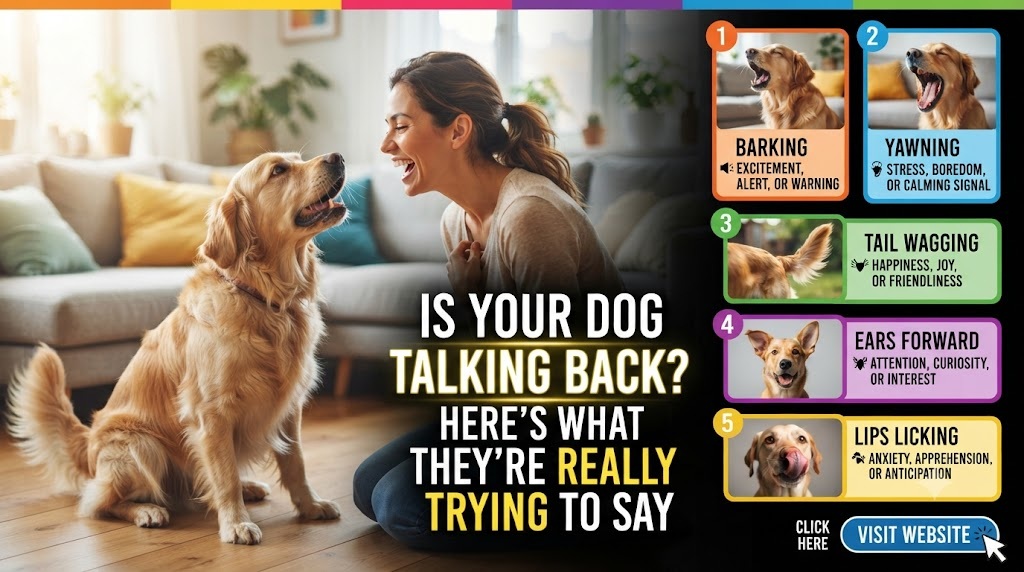
Does Your Dog “Talk Back”? Here’s What It Means: The Ultimate Guide to Canine Sass
In the world of dog ownership, we call this “talking back.” But is your dog actually arguing with you? Do they have a sense of sass, or is there a deeper, more biological reason for these vocal pyrotechnics?
Understanding why your dog “talks back” is more than just a fun party trick; it’s a window into their emotional world, their evolutionary history, and their unique bond with you. In this comprehensive guide, we will decode the sounds of canine sass, explore the breeds most likely to give you an earful, and teach you how to manage a dog that always wants the last word.
The Evolution of the “Talkative” Dog
To understand why a dog “talks,” we have to look back at their ancestors. Wolves, the wild cousins of our domestic companions, are actually relatively quiet animals. While they howl to communicate over long distances or bark to signal danger, they don’t spend their days “chatting” with one another.
So, why are our dogs so noisy? The answer lies in domestication. Over thousands of years, humans have selectively bred dogs that are more expressive. We needed dogs that could alert us to intruders, help us herd livestock, or signal when they found prey. In doing so, we inadvertently created an animal that uses vocalizations as a primary tool for interacting with humans.
Modern dogs have learned that humans respond to sound. We are a vocal species, and dogs have adapted to our “audio-centric” world. When your dog makes a strange noise and you laugh, take a photo, or give them a treat, you are reinforcing the idea that “talking” is a valid way to get what they want.
Decoding the Different Sounds of “Backtalk”
Not all “talk” is created equal. A “woo-woo” is very different from a sharp bark or a low grumble. To understand what your dog is saying, you need to listen to the pitch, the duration, and the frequency of the sounds.
1. The Low-Frequency Grumble (The “Complaint”)
This is perhaps the most common form of “talking back.” You tell your dog to get off the bed, and they slowly slide off while emitting a low-pitched, vibrating sound.
- What it means: This is often a sign of mild frustration or “protest.” It’s the canine equivalent of a heavy sigh. Your dog is complying with your command, but they want you to know they aren’t happy about it.
2. The High-Pitched “Woo-Woo” (The “Excitement”)
Common in breeds like Huskies and Malamutes, the “woo-woo” is a melodic, multi-tonal sound.
- What it means: This is usually a sign of high arousal and excitement. It’s a “happy” talk. Your dog is likely saying, “I’m so excited we’re going for a walk!” or “I’m so glad you’re home!”
3. The Short, Sharp “Huff” (The “Exasperation”)
If you’ve ever ignored your dog’s request for a treat, you might have heard a sharp exhale of air through their nose or mouth.
- What it means: This is pure exasperation. It’s a way for your dog to release tension when they aren’t getting what they want. It’s a “Fine, have it your way” kind of sound.
4. The Rhythmic Barking (The “Demand”)
This isn’t just one bark; it’s a series of repetitive, insistent barks directed straight at you while the dog makes eye contact.
- What it means: This is known as “demand barking.” Your dog isn’t just talking; they are giving you an order. “Feed me,” “Play with me,” or “Open this door” are the usual translations.
5. The “Singing” or Mimicry
Some dogs are experts at mimicking the cadence of human speech. While they aren’t using words, they are matching the rhythm and tone of your voice.
- What it means: This is a form of social bonding. Your dog is trying to “join the conversation” and mirror your energy levels.
The Most “Sassy” Breeds: Who Has the Most to Say?
While any dog can be vocal, some breeds are genetically predisposed to be “talkers.” If you own one of these breeds, you know that silence is a rare commodity.
The Siberian Husky
Huskies are the undisputed kings of talking back. They are famous for their “dramatic” temper tantrums. Because they are pack-oriented and were bred to communicate over long distances in harsh conditions, they have a massive vocal range. For a Husky, talking is a way of life.
The Beagle
As hounds, Beagles were bred to “give tongue” (bay) when they found a scent. This translates into a modern pet that has a lot to say about everything—from a squirrel in the yard to the fact that you’re five minutes late with dinner.
The Dachshund
Don’t let their small size fool you; Dachshunds are incredibly opinionated. They were bred to be brave hunters who could face off against badgers in tunnels. That bravery manifests as a dog that isn’t afraid to tell its owner exactly what it thinks.
The German Shepherd
Shepherds are highly intelligent and very “busy.” They often use vocalizations to “herd” their humans or express frustration when they don’t have a job to do. Their talk is often a mix of whines and deep, authoritative barks.
The French Bulldog
Frenchies are known for their “yodel.” Due to their unique airway anatomy and their desire for human attention, they make a variety of chirps, snorts, and gargling sounds that owners often interpret as conversation.
Why Does My Dog Talk Back? The Psychological Reasons
Beyond breed and evolution, there are specific psychological triggers that cause a dog to find their voice.
1. Seeking Attention
Dogs are social geniuses. They know exactly which behaviors get a reaction out of you. If “talking” results in you looking at them, talking back to them, or laughing, they will do it more often. To a dog, even a “scolding” (e.g., “Stop that noise!”) can be perceived as positive attention because you are engaging with them.
2. Frustration and Barrier Reactivity
If a dog wants something they can’t reach—like a toy under the sofa or a cat on the other side of a window—they may “talk” to express their frustration. This is an outlet for pent-up energy.
3. Mimicry and Social Bonding
Research has shown that dogs are highly tuned into human emotions and vocal patterns. When you talk to your dog in a high-pitched “baby voice,” they are more likely to respond with vocalizations of their own. It’s a way for them to feel connected to their “pack.”
4. Boredom
A dog that isn’t getting enough mental or physical stimulation will find ways to entertain itself. Sometimes, that means starting a “shouting match” with their owner just to break the monotony of the day.
Is “Talking Back” a Sign of Dominance?
There is an old-school myth in dog training that a dog talking back is trying to “dominate” their owner or show that they are the “Alpha.” Modern canine behavior science has largely debunked this.
“Talking back” is almost never about power; it’s about communication and emotion. A dog that grumbles when told to move is expressing discomfort or a desire to stay put, not a plot to take over the household. Treating vocalizations as “defiance” often leads to harsh training methods that damage the bond between dog and owner. Instead, it’s better to view these sounds as data—information about how your dog is feeling in that moment.
When Talking Becomes a Problem: Managing “Demand Barking”
While a sassy “woo-woo” can be cute, constant demand barking or screaming can become a nuisance. If your dog has learned that talking back is the way to get whatever they want, you need to implement some boundaries.
Step 1: Identify the Trigger
Does your dog only talk back when it’s dinner time? When you’re on the phone? When you’re ignoring them to watch TV? Identifying the trigger is the first step to changing the behavior.
Step 2: Stop Reinforcing the Noise
If your dog barks at you for a treat and you give them one to “shut them up,” you have just taught them that barking works. To stop this, you must become a “stone statue.” When the barking starts, turn your back, avoid eye contact, and do not speak. Only provide attention or rewards when the dog is quiet.
Step 3: Reward the “Quiet”
Positive reinforcement is key. Catch your dog being quiet and reward them for it. You can even put the behavior on command. Teach “Speak” first, and then teach “Quiet.” This gives you a “volume knob” for your dog.
Step 4: Increase Mental Stimulation
A tired dog is a quiet dog. If your dog is talking back out of boredom, increase their exercise or provide them with puzzle toys. Licking and chewing are naturally calming activities for dogs and can help reduce vocalizations.
The Role of Body Language: Reading the Whole Story
You can’t interpret a dog’s vocalizations without looking at their body. A “talkative” dog is sending a message with their entire being.
- Relaxed Body + Talking: This is usually playfulness or a desire for interaction. The tail may be wagging in a broad, loose motion.
- Stiff Body + Low Grumble: This is a warning. If the dog’s ears are pinned back and their body is tense, the “talk” is actually a precursor to a growl and should be respected as a request for space.
- Pacing + Whining/Talking: This often indicates anxiety or a physical need (like needing to go outside).
- Play Bow + “Woo-Woo”: This is an invitation to play. Your dog is saying, “I’m being sassy, but it’s all in good fun!”
The “Talking Button” Phenomenon: Science or Trickery?
In recent years, the internet has been flooded with “talking dogs” like Bunny the Sheepadoodle, who use AAC (Augmentative and Alternative Communication) buttons to “speak” to their owners. These dogs press buttons that say words like “Outside,” “Play,” or even “Stranger.”
While some skeptics argue this is just a clever version of “Clever Hans” (where animals respond to subtle human cues), many researchers are taking it seriously. It suggests that dogs have a much higher capacity for symbolic thought than we previously believed.
Owners of “button dogs” often report that their dogs become less vocally sassy once they have buttons. This suggests that some of the “talking back” we see is actually a result of the dog’s frustration at not being able to communicate specific needs.
Health Concerns: When “Talking” Means Pain
It is crucial to distinguish between a “sassy” dog and a dog in pain. If a dog that is usually quiet suddenly starts “talking” or grumbling when they move, jump, or are touched, it could be a sign of:
- Arthritis or Joint Pain: Common in older dogs, especially when they are asked to move from a comfortable spot.
- Dental Issues: Pain in the mouth can cause whining or strange vocalizations while eating or playing.
- Cognitive Dysfunction: In senior dogs, “talking” to walls or vocalizing late at night can be a sign of canine dementia (CCD).
If your dog’s vocal habits change suddenly, a trip to the vet is always the best first step.
Embracing the Sass: The Joy of a Vocal Dog
At the end of the day, having a dog that “talks back” is one of the many reasons we love them. It highlights their individuality and their desire to be an active part of our lives. When a dog “talks,” they are acknowledging you as a social partner.
Whether it’s a Husky telling you a long story about its day or a Terrier muttering under its breath because you won’t share your popcorn, these moments of “backtalk” are part of the unique language of your relationship.
By understanding the “why” behind the “woo-woo,” you can better meet your dog’s needs, manage their behavior, and enjoy the hilarious, heartwarming, and occasionally noisy journey of canine companionship.
Summary: Quick Guide to Canine Backtalk
| Sound | Potential Meaning | Body Language | Action to Take |
|---|---|---|---|
| Low Grumble | Mild protest/settling | Relaxed, “floppy” | Ignore or give a gentle command |
| High “Woo-Woo” | Excitement/Joy | Wiggling, tail wagging | Engage and play |
| Sharp “Huff” | Exasperation | Turning away | Check if needs (water, potty) are met |
| Repetitive Bark | Demand | Direct eye contact, stiff | Ignore until quiet |
| Whine/Talk | Anxiety or Need | Pacing, ears back | Investigate for stress or pain |
Does your dog talk back? Next time they give you a piece of their mind, take a second to look at the context. Are they bored? Excited? Or just being a Husky? Whatever the reason, it’s a sign of a dog that feels comfortable enough to express themselves—and that is a beautiful thing.
Frequently Asked Questions (FAQ)
1. Is it bad to talk back to my dog?
Not necessarily! If you enjoy the interaction and it’s not leading to aggressive behavior or nuisance barking, “talking back” to your dog can actually strengthen your bond. However, if you are trying to stop a behavior (like getting them off the couch), talking back can be seen as a reward, making the dog less likely to listen.
2. Can dogs actually learn to say words?
Dogs don’t have the vocal cords or lip structure to produce human speech sounds like “p,” “b,” or “m.” However, they are excellent mimics. When a dog sounds like they are saying “I love you,” they are actually mimicking the vowels and the pitch of the phrase they’ve heard thousands of times.
3. Why does my dog talk back specifically to me and not my partner?
Dogs often have different relationships with different family members. If you are the one who usually laughs at their “sass” or gives them treats when they make noise, they will target you. You may be the “fun” parent, while your partner is the “strict” one.
4. My dog “mumbles” when I tell them “No.” Should I be worried?
As long as the mumble isn’t accompanied by a lip curl, bared teeth, or a stiffened body, it’s likely just a “grumble” of protest. It’s the canine version of muttering under your breath.
5. At what age do dogs start talking back?
Vocalizations usually start in puppyhood but become more “articulate” as the dog reaches adolescence (6 to 18 months). This is the stage where dogs test boundaries, similar to human teenagers, and may become more vocally expressive.