

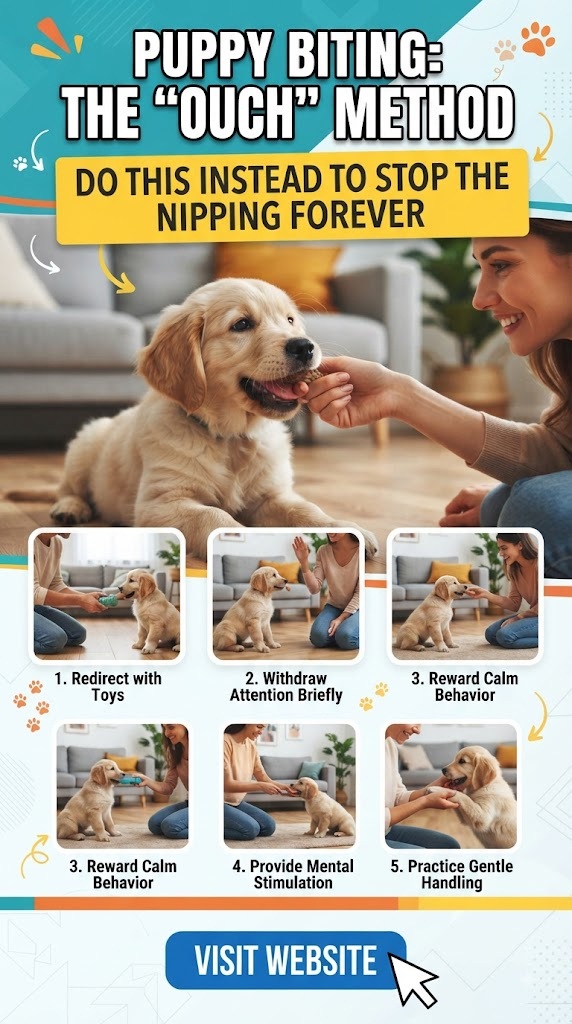
Puppy Biting: The “Ouch” Method is WRONG – Do THIS Instead to Stop the Nipping Forever
You brought home a bundle of fluff, a sweet-smelling, tail-wagging joy. But within forty-eight hours, that “angel” has transformed into a miniature “land shark.” Your hands are covered in scratches, your favorite leggings have holes in the ankles, and your kids are afraid to walk across the living room floor.
In your desperation, you turned to the internet or an old-school training book. The most common advice? “The Ouch Method.”
The theory suggests that when your puppy nips you, you should emit a high-pitched, loud “OUCH!” or “YELP!” to mimic a littermate. The idea is that the puppy will realize they hurt you and stop.
Here’s the cold, hard truth: For about 70% of puppies, the “Ouch” method makes the biting worse.
In this comprehensive guide, we are going to deconstruct why the “Ouch” method fails so spectacularly and provide you with a scientifically backed, force-free blueprint to transform your nipping puppy into a gentle companion.
Why the “Ouch” Method is Failing You
To understand why “Ouch” doesn’t work, you have to look at the world through your puppy’s eyes (and ears).
1. It Triggers Prey Drive
Many of the most popular dog breeds—Retrievers, Shepherds, Terriers, and Herding dogs—have a high “prey drive.” In the wild, prey is small, fast, and makes high-pitched, squeaky noises. When you yelp “OUCH!”, you aren’t sounding like a corrected littermate to your puppy; you are sounding like a squeaky toy. Instead of backing off, the puppy becomes more excited, thinks the “game” has just leveled up, and bites harder.
2. It Adds Energy to a High-Arousal Situation
Puppy biting usually happens when the puppy is already overstimulated. They are “zooming,” they are hyper, and their brain is firing at 100 miles per hour. By shouting or making loud noises, you are adding more “fuel” to their emotional fire. You are meeting high energy with high energy, which is the opposite of what a puppy needs to calm down.
3. The “Littermate” Myth
While it is true that puppies yelp when hurt by a sibling, you are not a puppy. Your puppy knows you are a human. Trying to mimic canine communication often leads to “lost in translation” moments. Furthermore, in a litter, a yelp is usually followed by the other puppy stopping the game entirely. Most owners yelp but then continue to move their hands or stay in the puppy’s space, sending mixed signals.
Understanding the “Why” Behind the Bite
Before we fix the behavior, we must understand why it’s happening. Puppies don’t bite because they are “dominant” or “aggressive.” They bite for four main reasons:
- Exploration: Puppies don’t have hands. They explore the texture, taste, and “give” of the world with their mouths.
- Teething: Between 12 to 24 weeks, puppy teeth are falling out and adult teeth are pushing through. This causes intense gum discomfort that can only be relieved by pressure (chewing).
- Overstimulation: When a puppy’s “internal bucket” is full of excitement, it overflows into mouthing.
- Overtiredness: Just like human toddlers, puppies get “cranky” when they need a nap. A puppy that is suddenly biting uncontrollably is often a puppy that has been awake too long.
Do THIS Instead: The 5-Step Professional Blueprint
If the “Ouch” method is out, what is in? The following system focuses on Negative Punishment (removing something the puppy wants—your attention) and Positive Reinforcement (rewarding the behavior you want).
Step 1: The “Reverse Time-Out”
This is the single most effective tool in your training arsenal. Instead of putting the puppy in “jail” (the crate), which can make them hate their crate, you put yourself in a time-out.
The Process:
- Engage in play with your puppy.
- The moment teeth touch your skin or clothes, say a calm “Too bad” or “Oops.”
- Immediately stand up, tuck your hands into your armpits (to remove the “moving target”), and walk out of the room or behind a baby gate.
- Wait for 20–30 seconds.
- Return and resume play calmly.
Why it works: You are teaching the puppy that “Teeth on skin = The fun stops.” Puppies are social creatures; their biggest reward is your engagement. By removing yourself, you are using the ultimate “punishment” without ever being scary or physical.
Step 2: Redirection (The “Pre-Emptive Strike”)
Redirection is only effective if done before the puppy latches onto you. If you wait until they are chewing your arm to offer a toy, you are accidentally rewarding the bite with a toy.
The Process:
- Always have a toy within arm’s reach.
- If you see your puppy getting that “crazy look” in their eye or heading for your feet, intercept them with a toy.
- Wiggle the toy on the ground like a prey animal to make it more interesting than your ankles.
- When they grab the toy, praise them lavishly.
Step 3: The “Enforced Nap” Protocol
Ninety percent of “problematic” puppy biting happens because the puppy is exhausted. Puppies need 18 to 20 hours of sleep per day. Most owners only give them 12 to 14.
The Strategy:
- Follow the “One Hour Up, Two Hours Down” rule. For every hour your puppy is awake and playing, they should have a two-hour nap in a quiet, dark space (like their crate or a playpen).
- If your puppy starts “sharking”—biting wildly, growling playfully, and refusing to listen—do not try to train them. They are overstimulated. Gently lead them to their nap area with a chew bone.
Step 4: Teach “Adult” Impulse Control
Puppies bite because they have zero impulse control. You can teach this through specific games.
- The “Leave It” Game: Place a treat in your closed fist. Let the puppy sniff and lick. The moment they pull their head away, say “Yes!” and give them a treat from the other hand.
- The “Hand Sprints” Game: Move your hand slowly. If the puppy stays calm, they get a treat. If they lung, the hand disappears. This teaches them that “calm hands” result in rewards.
Step 5: Master Bite Inhibition
There is a difference between “No Biting” and “Bite Inhibition.” Bite inhibition is the dog’s ability to control the pressure of their mouth. This is a life-saving skill. If a dog is ever startled or in pain later in life, a dog with good bite inhibition will “mouth” without breaking skin, whereas a dog who was never taught this may bite full force.
How to teach it: Allow very soft mouthing. Only use the Reverse Time-Out for hard bites initially. Once the puppy has learned to only mouth softly, you then raise the criteria and use the Reverse Time-Out for any mouth-to-skin contact.
Targeting Specific Biting Scenarios
The Ankle Nipper
Herding breeds (Border Collies, Aussies, Corgis) are notorious for this. Your movement triggers their instinct to “gather” you.
- The Fix: If your puppy nips your ankles while you walk, stop moving immediately. Become a statue. Herding dogs lose interest in things that don’t move. Keep a “distraction toy” in your pocket to toss away from you, giving you a chance to walk away while they chase the toy.
The “I Need to Go Potty” Bite
Sometimes, biting is communication. If your normally chill puppy suddenly starts frantically nipping at your hands, check the clock.
- The Fix: Take them outside immediately. Many puppies use mouthing as a way to say, “I have a physical need that isn’t being met!”
Biting During Leash Walks
This is often a sign of “frustration biting.” The puppy wants to go faster, or they are overwhelmed by the environment.
- The Fix: Don’t tug back on the leash (this turns it into a game of tug-of-war with your arm). Instead, drop a handful of small treats on the ground to engage their nose. Scent work lowers a dog’s heart rate and calms their brain.
Essential Tools for the Teething Phase
You cannot stop a puppy from chewing—it is a biological necessity. You can only control what they chew. Ensure you have a variety of textures:
- Cold/Frozen Toys: Wet a washcloth, tie it in a knot, and freeze it. The cold numbs the gums, and the texture feels great to chew.
- Hard Rubber: Classic Kongs or West Paw toys.
- Edible Chews: Bully sticks or collagen sticks (always supervised) provide a long-lasting outlet for the need to gnaw.
- Soft Plush: For “gumming” and carrying around.
What NEVER to Do
In your frustration, it’s easy to resort to old-school “dominance” tactics. Avoid these at all costs, as they often lead to fear-based aggression later in life:
- Holding the Muzzle Shut: This is terrifying for a puppy and teaches them that your hands are a source of discomfort.
- Alpha Rolls: Forcing a dog onto their back creates a “fight or flight” response. It destroys the bond of trust.
- Hitting or “Bopping” the Nose: This makes the puppy “hand shy.” They will start to flinch when you reach out to pet them.
- Spraying with Water: This just creates a dog that hates water, and it doesn’t teach them what to do instead of biting.
When to Seek Professional Help
Most puppy biting is normal and subsides by 6–7 months once the adult teeth are fully in. However, you should consult a certified positive-reinforcement trainer if:
- The puppy is stiffening their body and staring intensely before biting.
- The biting is accompanied by deep, guttural growling (different from high-pitched play growls).
- The puppy is guarding toys or food.
- You feel genuinely afraid of your puppy.
The “Light at the End of the Tunnel” Timeline
- 8–12 Weeks: The “Land Shark” phase. High frequency, low pressure. Focus on redirection and reverse time-outs.
- 12–16 Weeks: Peak Teething. The biting might get more intense as they lose teeth. Focus on frozen chews and enforced naps.
- 16–24 Weeks: Adult teeth coming in. If you’ve been consistent, you will see a massive decrease in biting.
- 6 Months+: The “Teenage” phase. Nipping should be almost non-existent, but they may “test” boundaries. Stay consistent!
Final Thoughts: Consistency is the Key
The reason the “Ouch” method is so popular is that it’s a “quick fix” attempt. But real training takes time. Your puppy’s brain is literally under construction.
If you use the Reverse Time-Out every single time teeth touch skin, and you ensure your puppy is getting enough sleep, you will see a transformation. It won’t happen overnight, but within 7 to 14 days of strict consistency, the “land shark” will begin to fade, replaced by a dog that understands how to interact with the human world.
Put the “Ouch” away. Stay calm, be boring when they bite, and be the most exciting person in the world when they choose a toy instead. Your scarred hands will thank you.