

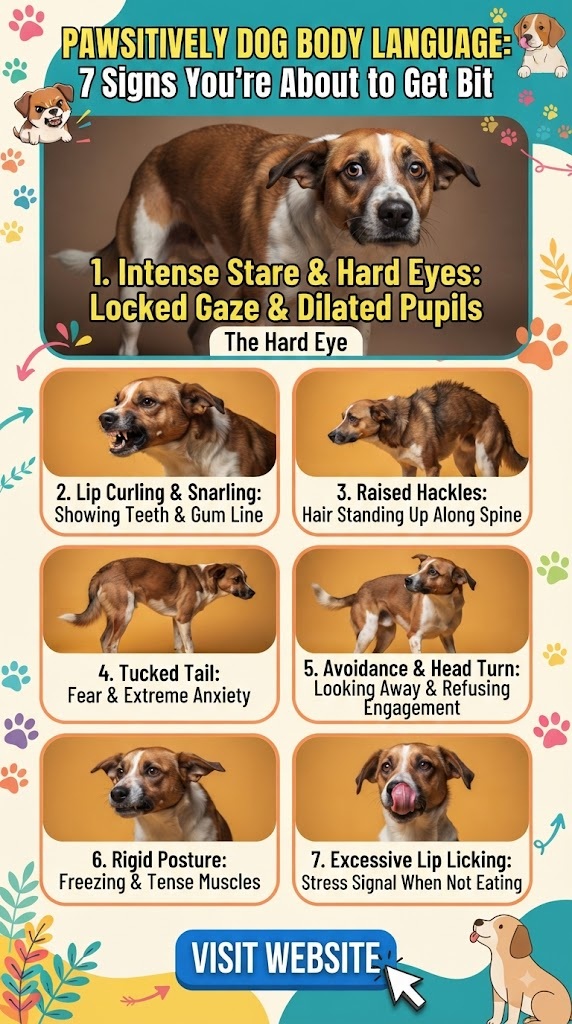
Dog Body Language: 7 Signs You’re About to Get Bit
“He bit me out of nowhere!”
This is perhaps the most common phrase heard by veterinarians, dog trainers, and emergency room doctors. But here is the cold, hard truth: dogs almost never bite “out of nowhere.” In the vast majority of cases, the dog has been screaming for help in their own silent language for minutes, hours, or even weeks before the actual strike occurs.
As humans, we are primarily verbal communicators. We use words to express discomfort. Dogs, however, communicate through a sophisticated system of posture, facial expressions, and micro-movements. When we miss these subtle cues, the dog feels forced to escalate. A bite is rarely an act of malice; it is usually a desperate final attempt to create space when all other forms of communication have failed.
Understanding dog body language isn’t just for professionals—it’s a vital life skill for every pet owner, parent, and animal lover. By recognizing these seven critical signs, you can prevent tragedies, build a deeper bond with your canine companions, and ensure everyone stays safe.
The “Ladder of Aggression”: Understanding the Escalation
Before diving into the specific signs, it is essential to understand the Canine Ladder of Aggression. Developed by pet behavior experts, this concept illustrates how a dog moves from mild discomfort to a full-blown bite.
- Low-Level Signs: Yawning, blinking, licking the nose.
- Moderate Signs: Turning the head away, walking away, sitting with a paw raised.
- High-Level Signs (The Danger Zone): Creeping, ears back, tensing up.
- The Strike Zone: Growling, snapping, and finally, biting.
When we ignore the low-level signs, we teach the dog that their “polite” requests for space are being ignored. If you punish a dog for growling, you are essentially “taking the battery out of the smoke alarm.” The dog may stop growling, but they are still “on fire” internally—and next time, they may skip the warning and go straight to the bite.
1. The “Freeze” (Sudden Rigidity)
One of the most dangerous signs a dog can give is one of the most frequently overlooked: the freeze.
If you are petting a dog and they suddenly go perfectly still, stop immediately. Many people mistake this stillness for the dog being “calm” or “obedient.” In reality, the dog has entered a state of high neurological arousal. They have stopped moving because they are deciding whether to “fight” or “fly.”
Why It Happens
When a dog freezes, their muscles become rock-hard. This is a predatory or defensive reflex. They are focusing all their energy on a potential threat (you, or whatever is bothering them). It is the “calm before the storm.”
What to Look For
- Locked Joints: The legs look like wooden stilts.
- Breath Holding: The dog may stop panting or breathing momentarily.
- Focused Gaze: Their eyes might be locked onto a specific object or person.
The Golden Rule: If the dog was wiggly and happy, then suddenly becomes a statue—back away slowly.
2. The “Whale Eye” (Half-Moon Eye)
In the world of dog behavior, “Whale Eye” is a massive red flag. This occurs when a dog moves their eyes but not their head, exposing the white part of the eye (the sclera) in a crescent or half-moon shape.
Decoding the Whale Eye
A relaxed dog usually doesn’t show the whites of their eyes. When they do, it typically means they are feeling anxious, guarded, or protective. You will often see this when a dog is “resource guarding” a bone or a toy. If you approach and they look at you sideways without moving their snout, they are warning you to stay back.
Scenarios Where You’ll See This
- Children Hugging Dogs: Dogs generally hate being hugged. If a child wraps their arms around a dog and you see the whites of the dog’s eyes, an intervention is required immediately.
- Veterinary Exams: Dogs who are terrified of being touched in certain areas will often exhibit whale eye.
- Food Aggression: If you walk past a dog while they are eating and they track your movement with their eyes while keeping their head over the bowl.
3. Displacement Behaviors: Lip Licking and Yawning
Not every yawn means a dog is tired, and not every lip lick means they are hungry. In fact, when these behaviors happen out of context, they are known as “displacement behaviors.”
The Psychology of Displacement
Imagine you are at a party and you feel socially awkward. You might check your phone (even if you have no notifications) or fidget with your keys. Dogs do the same thing. When they are stressed or conflicted, they perform a “neutral” behavior to try and self-soothe or signal to others that they are not a threat.
How to Spot the Danger
- The Yawn: A stress yawn is usually wider and more intense than a sleepy yawn. It may be accompanied by a high-pitched “whine-yawn” sound.
- The Tongue Flick: This is a quick, repetitive flicking of the tongue over the nose. It happens rapidly and is a clear sign the dog is trying to appease you because they feel threatened.
If you are leaning over a dog and they start licking their lips and yawning, they are saying, “I’m uncomfortable with how close you are. Please give me space.” If you continue to crowd them, their anxiety may turn into aggression.
4. The Myth of the Wagging Tail
One of the most dangerous misconceptions in the world is: “A wagging tail means a happy dog.”
This mistake leads to thousands of bites every year. A wagging tail simply indicates emotional arousal. It’s like a human smiling—people smile when they are happy, but they also smile when they are nervous, or even when they are being sinister.
Analyzing the Tail Wag
To understand if a wag is “friendly” or “ferocious,” you must look at the speed, height, and stiffness.
- The “Helicopter” Wag: A circular, loose, full-body wag that moves the dog’s hips. This is generally a safe, happy sign.
- The “Flag” Wag: The tail is held high and stiff, moving back and forth like a frantic flag. This is a sign of high confidence and potential dominance or aggression.
- The “Slow, Tense” Wag: If the tail is moving slowly and stiffly while the rest of the body is frozen, the dog is processing a threat. This is a “pre-bite” wag.
- The Low, Fast Wag: If the tail is tucked between the legs but wagging frantically at the tip, the dog is “fear-biting” territory. They are terrified and may snap out of self-defense.
5. The “Hard Stare” (Hyper-Focus)
In the animal kingdom, prolonged, direct eye contact is a challenge. While your own dog might look at you with “puppy dog eyes” to ask for a treat, a strange or stressed dog using a “hard stare” is doing something very different.
Eye Contact as a Weapon
A “hard stare” involves the dog locking eyes with you and refusing to blink. Their pupils may be dilated, making their eyes look black and intense. This is a predatory behavior or a direct threat.
The “Look Away” Test
A socially well-adjusted, friendly dog will usually look at you and then look away. This “breaking” of eye contact is a sign of politeness in dog language. If a dog refuses to break eye contact, even if you move, they are hyper-focused on you as a target.
Pro-Tip: If a dog is staring you down, do not stare back. Looking a dog in the eye during a confrontation can trigger an attack. Instead, look slightly to the side and turn your body away to show you are not a threat.
6. Piloerection (Raised Hackles)
You’ve likely seen it before: the hair along a dog’s spine stands up, making them look like a hyena. This is called piloerection, or more commonly, “raised hackles.”
The Biology of Hackles
This is an involuntary reaction caused by the sympathetic nervous system—the same thing that causes “goosebumps” in humans. It is triggered by a rush of adrenaline.
Does It Always Mean Aggression?
Not necessarily, but it always means high arousal. A dog may have their hackles up because they are excited, surprised, or intensely interested. However, when combined with any of the other signs on this list (like a growl or a freeze), it indicates that the dog is prepared to defend themselves or attack.
Think of raised hackles as a “Warning: High Voltage” sign. The dog’s internal system is redlining, and any further stimulation could push them over the edge.
7. The Final Warnings: Growling and Lip Curling
We often think of growling as the start of aggression, but it is actually one of the last things a dog does before biting. It is their way of saying, “I have tried being subtle, and you didn’t listen. Now I’m being loud.”
The Lip Curl (The Snarl)
Before a dog growls, they often “lift” their lips to show their teeth. This is a clear anatomical demonstration of the weapons they possess. They are showing you exactly what will happen if you continue your current course of action.
The Growl: A Gift You Should Never Punish
Many owners scold their dogs for growling: “Don’t be mean!” or “No growling!”
This is a dangerous mistake. If you punish a dog for growling, you are effectively teaching them that their warning system is “bad.” The dog still feels the same level of fear or anger, but they learn to hide it. This creates a “silent biter”—a dog that goes from 0 to 60 with no vocal warning.
What to do instead: If a dog growls, immediately stop what you are doing. Give them space. Later, work with a professional to address the source of the stress, rather than punishing the symptom.
Why Humans Misinterpret These Signs
The biggest reason people get bit is that they anthropomorphize dogs—meaning they project human emotions and logic onto canine behavior.
1. The “Guilty” Look
When a dog cringes, puts their ears back, and licks their lips, humans say, “He knows he did something wrong!” In reality, the dog is showing appeasement behaviors. They aren’t feeling “guilt”; they are reacting to your angry tone of voice or body language and trying to de-escalate the situation because they feel threatened.
2. The Need to “Say Hi”
Humans are tactile. We want to pet every dog we see. However, many dogs find being touched by strangers—especially on the head—to be incredibly invasive. When you reach over a dog’s head, you are blocking their vision and looming over them, which is a classic “threat” posture in the animal world.
3. Ignoring the Context
A dog might be fine with you touching their paws while they are lying on the couch, but if you do it while they are cornered in a vet’s office, their reaction will be entirely different. Always consider the environment and the dog’s overall stress level (their “stress bucket”).
The “Stress Bucket” Theory
Think of a dog’s ability to cope as a bucket.
- A loud truck drives by (Add a cup of water).
- A neighbor’s dog barks at the fence (Add a cup of water).
- The owner is late with breakfast (Add a cup of water).
- A stranger tries to pet the dog’s head (The bucket overflows).
The “overflow” is the bite. Often, the thing that triggers the bite isn’t a huge deal on its own, but it was the final drop in a bucket that was already full. This is why a dog might seem “fine” one minute and “aggressive” the next.
How to Properly Approach a Dog (and Avoid a Bite)
To stay safe and be a “dog-literate” human, follow these steps when interacting with any dog:
- Ask the Owner: Never pet a dog without permission.
- Ask the Dog: This is the step everyone skips. Stand a few feet away, turn your body slightly to the side (less threatening), and see if the dog approaches you. If the dog doesn’t move toward you, they don’t want to be petted.
- The “Consent Test”: Pet the dog for three seconds on their chest or side (not the head). Stop. If the dog moves closer or nudges your hand, they want more. If they look away, lick their lips, or move away, they are finished.
- Avoid the “Three Cs”: Don’t Corner, don’t Crowd, and don’t Chug (hug/kiss).
Special Note: Children and Dog Safety
Children are the most frequent victims of dog bites, and most of these bites come from the family dog or a friend’s dog. This is because children:
- Have high-pitched voices (which can sound like prey).
- Move sporadically and quickly.
- Often ignore personal space (hugging, climbing on dogs).
- Stare directly into a dog’s eyes.
Supervision is not enough. You must be able to “read” the dog. If you see your child approaching the dog and the dog’s ears go back, or they do a quick lip lick, you must intervene. Don’t wait for a growl. By the time the dog growls, they are already at their breaking point.
What to Do If a Dog Becomes Aggressive
If you find yourself facing a dog that is showing several of these seven signs, do not panic. Your reaction determines whether the situation de-escalates or turns into an attack.
- Be a Tree: Stand still. Fold your arms. Do not scream and do not run. Running triggers a dog’s “prey drive,” and they will instinctively chase you.
- Avert Your Gaze: Look at the ground or off to the side.
- Create Distance Slowly: Once the dog seems to settle slightly, back away slowly and diagonally. Do not turn your back on the dog until you are a safe distance away.
- Use a Barrier: If you have a bag, a jacket, or an umbrella, put it between you and the dog. This creates a physical “buffer” and gives the dog something else to bite if they do strike.
Conclusion: Becoming a Canine Advocate
Dogs give us their absolute best every day. They provide companionship, protection, and unconditional love. The least we can do in return is learn to speak their language.
When you recognize the freeze, the whale eye, the stress yawn, and the stiff wag, you aren’t just preventing a bite—you are advocating for a living being who is trying their best to navigate a human world.
If your dog is showing these signs frequently, don’t wait for an accident to happen. Reach out to a certified professional dog trainer or a veterinary behaviorist who uses positive reinforcement methods. Understanding why your dog is stressed is the first step toward a happier, safer life for both of you.
Remember: A dog that bites is usually a dog that was ignored. Start listening to the silence, and you’ll never be surprised by the “out of nowhere” bite again.