

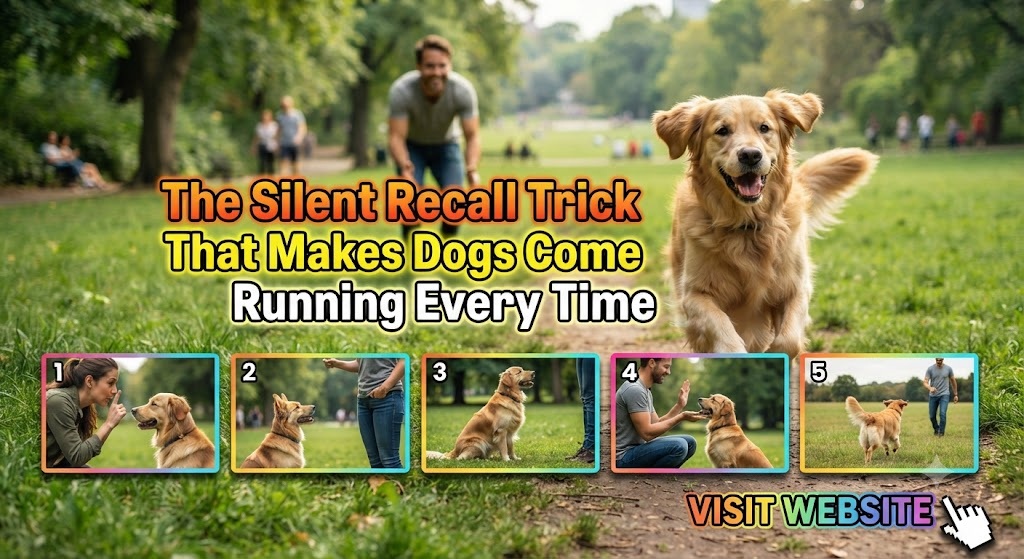
The “Silent Whistle” Trick That Recalls Your Dog From ANY Distance
Imagine this: You’re at the park, and your dog spots a squirrel across a busy field. Before you can even utter their name, they are a blur of fur and adrenaline, charging toward the horizon. You yell, you scream, you whistle with your lips until your face turns red—but your dog doesn’t even flinch. To them, your voice is just background noise, a frantic sound easily drowned out by the wind, the rustle of leaves, and the pounding of their own heart.
Now, imagine a different scenario. Your dog is 200 yards away, deep in the brush. You pull a small, metal device from your pocket and deliver a short, silent puff of air. To any human nearby, it sounds like nothing more than a faint hiss. But to your dog, it’s a clarion call. They whip their head around, abandon the chase, and come sprinting back to you with a wagging tail.
This isn’t magic. It’s the “Silent Whistle” Trick, a specialized training protocol used by professional hunters, search-and-rescue teams, and elite trainers to achieve “bulletproof recall.”
In this comprehensive guide, we will break down why the silent whistle is the ultimate tool for off-leash freedom and how you can use it to recall your dog from any distance, regardless of distractions.
Why Your Voice is Failing You
Most dog owners rely on their voice for recall. While “Come!” works in the living room, it often fails in the real world for three primary reasons:
1. The Emotional Variable
When you are scared, frustrated, or angry because your dog isn’t listening, your voice changes pitch and tone. Dogs are masters of reading human emotion. If your “Come!” sounds like a threat, your dog is biologically programmed to avoid the conflict. The silent whistle, however, has no emotion. It is a consistent, neutral frequency every single time.
2. The Sound Decay Factor
Human speech is composed of low and mid-range frequencies that dissipate quickly over distance and are easily muffled by wind, rain, or physical barriers like trees. A silent whistle operates on a high-frequency ultrasonic level. These waves travel further, cut through ambient noise, and reach the dog’s ears with pinpoint clarity.
3. The “White Noise” Effect
Your dog hears your voice all day. You talk to them, you talk to your spouse, you talk on the phone. Your voice becomes “background noise.” A whistle is a distinct, unique signal that is reserved for one thing and one thing only: Coming back to you.
The Science of the Silent Whistle (Ultrasonic Training)
Dogs can hear frequencies up to 45,000 Hz, whereas humans generally tap out at 20,000 Hz. A “silent” whistle (often called a Galton’s whistle) is adjustable and typically operates in the 15,000 to 25,000 Hz range.
Because the frequency is so high, it bypasses many of the distractions that plague the human ear. More importantly, it exploits a dog’s natural predatory hearing. In the wild, small rodents emit high-pitched squeaks. A dog’s ear is evolutionarily tuned to snap to attention when it hears a high-frequency sound. By using a silent whistle, you are hacking into your dog’s biological hardwiring.
Choosing the Right Equipment
Not all whistles are created equal. To master the “Silent Whistle” Trick, you need the right gear.
- Adjustable Frequency: Look for a whistle with a screw-sleeve that allows you to change the pitch. Every dog has a “sweet spot” frequency where they are most responsive.
- Durability: Since you’ll be using this outdoors, choose stainless steel or high-quality brass.
- Consistency: Avoid cheap plastic toys. You need a whistle that produces the exact same frequency every time you blow.
- The Lanyard: Never carry the whistle in your pocket. It must be around your neck, ready for instant use. A second’s delay can be the difference between a successful recall and a dangerous situation.
Phase 1: “Charging” the Whistle (The Secret Sauce)d.
Step 1: The Treat Test
Find a “Level 10” treat. This shouldn’t be a dry biscuit. Think boiled chicken, freeze-dried liver, or bits of steak. This reward is for whistle training only.
Step 2: The Pairing
In a quiet room with no distractions, blow a short blast on the whistle. The moment you blow, give your dog a piece of the high-value treat. Do not ask for a sit. Do not say “Come.” Just: Sound -> Treat.
Step 3: Repetition
Repeat this 10 to 15 times a day for three days. You are building a Pavlovian response. You want your dog’s brain to create a neural pathway that says: That sound means the best thing in the world is about to happen.
Pro Tip: If your dog looks at you expectantly when they hear the whistle, the whistle is “charged.”
Phase 2: The Kitchen Recall
Now that the sound is associated with food, you need to turn that association into movement.
1. Why Reliable Recall Is One of the Most Important Skills
- What recall training really means
- Why every dog should master the “come” command
- How reliable recall can prevent dangerous situations
- Common myths about off-leash obedience
2. What Is the “Silent Whistle” Trick?
- Understanding silent dog whistles and ultrasonic sound
- How dogs hear frequencies humans can’t
- Why a consistent sound can outperform shouting
- The science behind conditioned recall
3. Why Dogs Ignore Their Owners
- Too many distractions
- Weak reward history
- Repeating commands too often
- Punishing your dog after it returns
- Expecting perfect recall too soon
4. Choosing the Right Silent Whistle
- Adjustable vs. fixed-frequency whistles
- Features to look for
- Indoor vs. outdoor use
- Mistakes to avoid when buying
5. Before You Start Training
- Best age to begin
- Rewards that motivate your dog
- Finding distraction-free training areas
- Essential equipment you’ll need
6. Step-by-Step: Teaching the Silent Whistle Recall
Step 1: Introduce the whistle
Step 2: Pair the whistle with high-value treats
Step 3: Reward every successful response
Step 4: Increase distance gradually
Step 5: Add mild distractions
Step 6: Practice in different locations
Step 7: Build reliability before going off-leash
7. The Golden Rule: Make Coming Back Worth It
- Use irresistible rewards
- Celebrate every successful recall
- Keep training fun
- End sessions on a positive note
8. Common Recall Training Mistakes
- Blowing the whistle repeatedly
- Calling your dog for unpleasant experiences
- Training only indoors
- Moving too quickly
- Losing patience
9. Best Rewards for Strong Recall
- Chicken, turkey, and cheese
- Favorite toys
- Praise and affection
- Games like tug and fetch
- Variable reward schedules
10. Training Around Real-Life Distractions
- Other dogs
- Squirrels and wildlife
- Parks and beaches
- Children playing
- New environments
11. How Long Does Recall Training Take?
- What to expect in the first week
- One-month progress
- Long-term maintenance
- Factors that affect learning speed
12. Troubleshooting Recall Problems
- Dog ignores the whistle
- Dog comes halfway then stops
- Dog responds only indoors
- Dog runs away after returning
- Older dogs learning new skills
13. Safety Tips for Off-Leash Adventures
- Know local leash laws
- Choose safe training locations
- Use GPS collars if needed
- Never rush off-leash freedom
14. Can Every Dog Learn Reliable Recall?
- Puppies
- Adult dogs
- Rescue dogs
- Senior dogs
- High-prey-drive breeds
15. Frequently Asked Questions
- Is a silent whistle better than voice commands?
- Can dogs hear every silent whistle?
- How often should I practice?
- Can I use both voice and whistle commands?
- Will this work for stubborn dogs?
16. Expert Tips for Faster Results
- Train for 5–10 minutes daily
- Practice in different environments
- Reward unpredictably after your dog learns
- Stay calm and consistent
- Make recall the best part of your dog’s day
Conclusion
- Key takeaways from the silent whistle method
- Why consistency beats force
- Building a lifelong habit of reliable recall
- Final encouragement for dog owners
Bonus: Quick Recall Training Checklist
- ✅ Choose a quality silent whistle
- ✅ Use high-value rewards
- ✅ Practice every day
- ✅ Increase distance gradually
- ✅ Train with distractions slowly
- ✅ Never punish your dog for returning
- ✅ Keep sessions short and enjoyable
- ✅ Continue practicing throughout your dog’s life
Phase 3: Introducing the Long Line
Never go straight from the kitchen to an open field. The transition from a controlled environment to the “Great Outdoors” is where most training fails. This is where you use a Long Line (a 15-to-30-foot training leash).
The “Safety Net” Method
Go to your backyard or a quiet park. Let your dog wander to the end of the long line.
- The Blast: Blow the whistle.
- The Prompt: If they don’t turn immediately, give a very gentle tug on the long line to guide them toward you.
- The Celebration: As they move toward you, use “verbal bridge” praise (“Good boy/girl!”). When they reach you, deliver the high-value reward.
The long line ensures that the dog never learns they can ignore the whistle. If they ignore it, you physically (but gently) show them what the correct response is.
Phase 4: Distraction Management (The 3-D Rule)
To recall a dog from any distance, you must master the 3 Ds: Distance, Duration, and Distraction.
1. Distance
Gradually increase how far away the dog is when you blow the whistle. Start at 10 feet, then 20, then 50, then 100.
2. Duration
Ensure the dog stays with you for a few seconds after the recall before releasing them back to “go play.” This prevents “touch and go” behavior where the dog grabs the treat and bolts again.
3. Distraction
This is the final boss. Start training near a fence where other dogs are barking, or near a pile of leaves. Use the whistle to pull their attention away from the distraction. If they succeed, the reward must be massive.
Advanced Technique: The “Emergency Recall” Sequence
There is a difference between a “Casual Recall” (Come here so I can put your leash on) and an “Emergency Recall” (Stop chasing that car right now).
For the Silent Whistle Trick, use a specific rhythm for emergencies. Many trainers use a rapid-fire triple blast.
- Casual: One long whistle.
- Emergency: Three short, staccato blasts.
In your training, the triple blast should always result in a “Mega-Jackpot” (half a tin of sardines or a whole handful of chicken). This creates a “Super-Command” that the dog will obey even in the heat of a chase.
Common Mistakes That Ruin the Trick
Even with the best whistle, you can fail if you fall into these common traps:
1. Poisoning the Cue
Never, ever use the silent whistle to call your dog for something they dislike. If you whistle and then immediately give them a bath, clip their nails, or put them in the crate to leave, the whistle becomes a “warning” rather than an “invitation.” For the first six months, only whistle for positive outcomes.
2. The “Echo” Mistake
Don’t blow the whistle over and over if the dog doesn’t come. If you blow it five times and they finally come on the sixth, you have just taught them that the first four blasts are optional. Blow once. If they don’t respond, use the long line or go get them.
3. Fading the Reward Too Fast
Owners often stop giving treats once the dog “gets it.” For recall, you should never fully stop rewarding. Think of it like a slot machine. If the machine never pays out, you stop playing. Keep the “payouts” unpredictable but frequent enough to keep the dog “gambling” on a big win.
Troubleshooting: What if My Dog Ignores the Whistle?
If you are out in the field and your dog ignores the “Silent Whistle” Trick, do not panic.
- Check the Frequency: Is the screw loose? The pitch might have shifted to a range they don’t hear well.
- Back to Basics: Go back to Phase 1 (Charging) for a few days. Your “Bank Account” of reinforcement might be empty.
- The “Run Away” Maneuver: If your dog looks at you but doesn’t come, blow the whistle and run in the opposite direction. This triggers their chase instinct. When they catch up to you, reward them heavily.
Why This Saves Lives: Real-World Applications
The silent whistle isn’t just a party trick; it’s a life-saving tool.
The Sight Hound Dilemma
Breeds like Greyhounds, Whippets, and Salukis have a “prey drive” that overrides their hearing. Their brains literally shut off auditory input when their eyes lock onto a target. The high-frequency whistle is often the only thing sharp enough to break that visual trance.
The Senior Dog
As dogs age, they often lose the ability to hear lower frequencies (like the human voice) first. Many owners think their dog is becoming “stubborn” or “senile,” when in fact the dog simply can’t hear them. Silent whistles, being high-frequency, are often still audible to senior dogs, giving them a “second life” of off-leash freedom.
The Weather Factor
In a heavy windstorm or near a roaring river, your voice is useless. The silent whistle’s ultrasonic waves slice through the white noise of nature, ensuring your dog can always find their way back to your side.
The 30-Day Mastery Schedule
If you want to achieve “Recall From Any Distance,” follow this 30-day roadmap:
- Days 1-5: Charge the whistle. 20 repetitions a day. Sound = Treat. No movement required.
- Days 6-10: Low-distraction recalls. Kitchen, hallway, bedroom.
- Days 11-15: Backyard recalls on a 10-foot leash.
- Days 16-20: Park recalls on a 30-foot long line. Introduce mild distractions (distant birds, other people).
- Days 21-25: The “Hidden Recall.” Hide behind a tree or a door, blow the whistle, and have the dog find you. This builds the “search” element of the recall.
- Days 26-30: Off-leash in a safe, fenced area with high distractions. Use the “Emergency Triple Blast.”
Maintaining the Trick for Life
Once your dog is recalling like a pro, you must maintain the behavior. The silent whistle should be seen as a “precious resource.”
- Monthly Tune-ups: Once a month, spend five minutes “re-charging” the whistle in the kitchen with the highest-value treats possible.
- Vary the Rewards: Sometimes it’s a treat, sometimes it’s a game of tug, sometimes it’s a belly rub. Keeping the reward varied keeps the dog’s interest high.
- Test the Distance: Every so often, test the limits. When you’re in a safe, open space, wait until the dog is a significant distance away before calling. You’ll be amazed at how far the sound carries.
Conclusion: The Path to Total Freedom
The goal of the “Silent Whistle” Trick isn’t about control; it’s about freedom.
A dog that can be recalled from any distance is a dog that gets to go on more hikes, explore more off-leash trails, and enjoy a life of adventure. You no longer have to live in fear of the “open gate” or the “slipped collar.”
By harnessing the power of ultrasonic frequencies and the principles of positive reinforcement, you are building a bridge of communication that is invisible, silent, and unbreakable.
Pick up a whistle, grab some chicken, and start today. Your dog—and your peace of mind—will thank you.
Frequently Asked Questions (FAQ)
Is the silent whistle painful for dogs?
No. When used correctly, it is no different than any other sound. It is simply a high-pitched note. However, you should never blow the whistle directly into a dog’s ear, as any loud noise at close range can be startling or uncomfortable.
Can I use this for multiple dogs?
Absolutely. You can actually train different “codes” for different dogs. For example, Dog A responds to two short blasts, while Dog B responds to one long blast. Or, you can train them all to return on the same signal for a “group recall.”
My dog is deaf. Will a silent whistle work?
It depends on the type of deafness. Some dogs lose hearing in certain frequency ranges but retain it in others. However, if a dog is 100% deaf, the whistle will not work. In those cases, “vibration collars” (not shock collars) or visual signals (strobe lights) are the alternative.
How do I find the right frequency for my dog?
Wait until your dog is asleep or relaxed. Blow the whistle at the lowest setting and gradually turn the adjustment screw. When your dog’s ears twitch or they look up, you have found a frequency they can hear clearly. Lock the screw in place at that setting.
Does it work on all breeds?
Yes. While some breeds (like Hounds or Huskies) are more “independent” and may take longer to train, the biological mechanics of hearing and the psychological principles of conditioning apply to all dogs, from Chihuahuas to Great Danes.